


Tonight’s guest blogger is my dear friend, Dave Wolanski, an incredibly talented photographer from Delaware, who has a very unique specialty. His favorite camera to shoot with is a toy. A plastic toy camera. Yup, no joke! Want to know more? Check out Dave’s thoughts on the infamous Holga! And be sure to click anywhere in this paragraph to check out his website, too. 🙂
 Photo Credit – Wendi Riggens

Photo Credit – Tobie Allison
I’d like to thank Wendi for asking me to write a guest post on her blog about my interest in using Holga cameras. I certainly talk about them and show plenty of work I’ve done with them! For those that don’t know what a Holga camera is, it’s an inexpensive (as low as $20 but usually $30) toy camera that is made almost entirely of plastic in China, lens and all. The only metal in it is part of the shutter assembly. It was originally developed as a camera for the folks in China to use as their everyday camera. For those of you not interested in technical stuff, feel free to skip the next paragraph. It’ll be photo geek stuff you can safely ignore if you choose to.
Holgas use medium format film that use negatives about 4 times the size of “regular” 35mm film. Unlike standard SLR 35mm cameras, when you look through the view finder, you’re not seeing what the camera is focused on. You’re just getting a close approximation of what the camera is focused on. Because it’s not through the lens, it’s possible to shoot the camera with the lens cap on if you don’t take it off first! You also have to manually advance the film. If you forget to do so, the camera is perfectly happy to make multiple exposures on the same bit of negative. If you don’t advance the film far enough (also easily done)you’ll double expose the area that overlaps. This camera is a sort of a zoned range finder, so you set the distance (sort of) using a ring on the lens to guess at the distance you’re focusing the camera. The shutter only has 2 available settings for aperture and one shutter speed. One of the aperture settings is sunny, the other is cloudy. Finally, the camera is prone to both vignetting (dark corners) and random light leaks that affect the film in a number of ways that would be a nightmare on a more technically correct camera.
For those of you that skipped the tech stuff, welcome back!
I have a full on Canon digital camera outfit that gives me 22 megapixels of digital camera goodness for each photo. I enjoy it for the high technical quality of the images, the instant feedback of the images on the back of the camera and the ability to alter those images in my digital darkroom. For critical stuff, when digital perfection is needed, with no chance of a do-over, that Canon rig is a clear choice.
When I want to get my art groove on, I turn to the Holgas and shoot them. For all their technical failings, Holgas give me images I love! Because the lens is plastic I get images that are sharp in the middle and blurred on the outside. This gives me dream like images. I can shoot double or triple exposures if I like, layering one idea on top of another. Because there are only two settings for the camera opening I don’t have to worry about those when I’m shooting. I just look around. Is it bright or dull here? Pick the right one and move on. I don’t have to worry about shutter speeds, there is only one. What I have to think about then is the most important thing anyways. What am I seeing? How can I fill the frame with it? Is the frame filled? Is the focus more or less the right distance? Is the lens cap off? Actually, the lens cap get thrown out when I bring the cameras home. Seems if you leave it on, you might waste 6 shots of film. Or the entire roll. Don’t ask me how I know.
For a long time I’ve enjoyed shooting with the Holgas for a variety of reasons. Foremost, I like the images! They speak to my inner artist. Generally I shoot them in black and white, and use the square mask instead of the rectangular one to get bigger, square images. Between the soft focus and the vignetting, the images very much remind me of a still from a movie. The viewer can fill in their own story on what is happening with the image. They don’t need all the details and perfection of a digital photograph.
One of the things I really like about making photos with the Holga is the whole process. Because the camera uses film that has to be developed, at roughly $10 a roll when all is said and done, it’s important not to waste film if possible. I have greatly reduced my developing costs for Black and White photos by developing the film and scanning it myself. Developing B&W isn’t that hard at all once you’ve done it a few times and my cost per roll is about $2. I have to load the camera with film and set it up for the first photos by winding the film until it’s in place and ready to go.. I have to find the perfect scene(s) to fill the frame with. Is there anything in the viewfinder that will distract from the photos? Telephone poles? Trash on the ground? Someone walking by in the background? Fix that first by policing the area or moving to another angle. Then when the time is right, I take the photo, and , hopefully advance the film immediately. Did I get the shot? Maybe. Most likely. Now is the time to recheck the focus and make sure I had it right before moving on. Is there another more interesting angle? Go for it!
Another primary reason I like to use Holgas is to embrace imperfection. It seems in the world today that things must be absolutely perfect, or they are unacceptable. This is particularly true in digital photos, where we use thousands of dollars of software and computers to remove every.single.imperfection. One apparent end result of that is that some folks can only see blemishes in others. Or even in themselves. Face it. There are no perfect people in the world. We all have “flaws” that really aren’t, but we sure feel bad about them! The photos I get are very much a statement that “this is beautiful, warts and all”.
The last of many reasons I could tell you about for now is that I like my photos to be timeless. If I didn’t tell you I took the photos last week or last year, you might think they were done any time since the Civil War when photos were first being taken. That’s obviously not true for modern content, but for older stuff…
I know what you’re thinking: Enough Talk! Show us some photos!
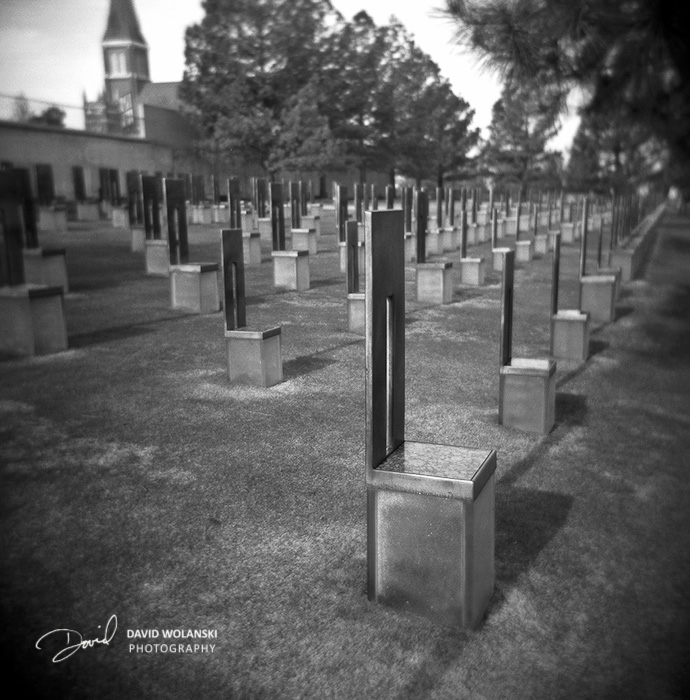
This first image taken at the Oklahoma City National Memorial is kind of typical of a Holga photo. Sharp in the middle and the items near the edge are blurred and slightly out of focus. Like many of my Holga images, this was about the shapes and arrangements. I got the message across about the number of folks killed without giving you mind numbing detail.
Here is an intentional double exposure done at the memorial too. I took advantage of a nearby Church memorial to overlay the image of Jesus weeping on the memorial chairs.

This photo won an Honorable Mention in a photo contest here in Delaware last year. I was pretty proud of that. I call it “Return to the Sea”. The more sharp eyed folks will notice a few imperfections in the scan. There is dust, some fibers and a few half moons where I damaged the negatives in processing. Oh well. Still love the photograph.
Here are a few color images.
This was taken along Rt. 66 somewhere near Tulsa Oklahoma. It reminds me of a movie from the 40s or 50s and makes me wonder about how something that at one time was an important building is now abandoned. Notice the vignetting here?
Taken in Clarksdale Mississippi, I was pretty sure I’d get the flare here when I took the photo, but wasn’t totally sure till I got it back from the lab. Without being told, I doubt you’d know when this was done. To me, it’s like a faded memory of an older man, thinking back on that hot summer in 1958 when he was in his early 20s and his old truck he loved so much…
This photo from Pomfret Center Connecticut is another timeless favorite. A new England memory on film.
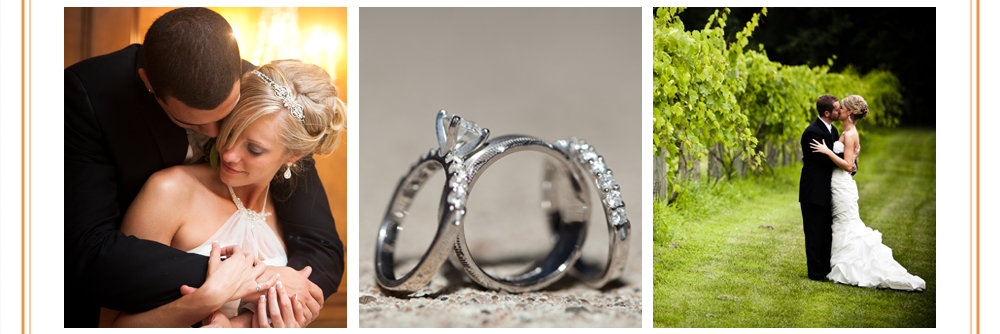
Since Wendi is a wedding photographer, here are a few photos I did at a wedding that I was acting as a second shooter at. I was inspired to try these by the photos done by Erin Antognoli (check her website, amazing stuff!) and my own experience shooting other events and general Holga background. Before the wedding, I got the bride and grooms permission to try a few rolls with the understanding that because of their nature, the Holga photos weren’t guaranteed, but should come out great and would be a cool addition to their wedding photos. One of the cool things about being a second shooter at a wedding is you can try some stuff on the sidelines knowing that the main shooter is getting the absolute must have images. Anyways, here are some of my favorites. Interestingly enough, the primary photographer and I delivered about 1500 digital photos and 20 of these Holga photos to the bride and groom. Guess which ones they talked about the most…
I’d like to thank Wendi once again for this pulpit to preach from. Feel free to check out my blog at www.davidwolanski.com and my facebook page at https://www.facebook.com/david.wolanski to see other Holga work or contact me with any burning questions.


by Wendi Riggens
Dave - Thanks again for the chance to be a guest blogger on your Blog Wendi!
Sharp eyed viewers might notice in the photo of me at the top of the post in the blue jacket with 4 cameras on, that 2 of them are Holgas (one loaded with color film, and the other with black and white) one is a Canon film camera that I got for $25 off Craigslist (film cameras are stupid cheap on Craiglist these days! Camera systems that cost $1000 new in the 70s and 80s can be had for $150) and the biggest one is my Canon 5DMkII. The lens on the Canon film camera is worth more than the Canon film camera and the two Holgas, combined!
They might also notice the iPhone camera I have on my hip too.
5 cameras at one time is perfectly normal, right?
Jennifer Robinson - Great information Dave. As always, enjoy reading your enthusiasm for your inner artist!
Peggy - Wow, how original. Love how Dave is not afraid to be himself behind the lens and shoot what he loves.
Jamie Koppi - I absolutely love Dave’s Holga work, and knowing him personally, I know that he is an amazing guy, thanks for sharing your info Dave!